


As a PPC campaign manager, accurate measurement is everything. Without it your campaigns are flying blind, and the results show it. And few things break measurement as quietly as Meta data sharing restrictions.
So what happens when everything looked fine on Friday in the Meta campaigns for the dental practice you run ads for, and on Monday you find out that not a single lead came in all weekend? The campaign starts drying up: on Friday it could see the conversions, on Monday it can’t. Nobody changed anything in between. Strange. Very strange. Analytics looks fine, but Meta simply doesn’t see the conversions. Time to start worrying.
What’s going on?
Meta continuously watches the data coming in through the pixel and the CAPI, and infers from it what a given site is about. It looks at the hostname, the page path and the URL parameters. Then it sorts sites into categories based on the URLs it finds. The point of all this is to catch sites that may be sending Meta data they shouldn’t under the Business Tools Terms.
And the terms do include a clause saying you can’t send health information to Meta. So if the Meta pixel fires on, say, bestever.md/ear-nose-throat-surgery (made up), you’re sending Meta health information, plain and simple. Anyone browsing that page probably has a condition that calls for that kind of treatment, and there you have it, prohibited data shared with Meta.
So now you’re on the wrong side of the terms, even though you didn’t really do anything wrong. The pixel is just sitting there on the site. It’s alarmingly easy to walk into a restriction like this, and getting back out is another story entirely.
Which topics does Meta restrict?
Beyond healthcare sites, it restricts gambling, adult, firearms, religion, tobacco and fintech topics, among plenty of others. Customer portals and sites behind a registration gate often get restricted too.
Still, the restriction that causes the most headaches for advertisers is the one hitting healthcare and dental sites. That’s an enormous market, and a huge number of clients can be caught up in it.
Third-party booking systems
Worth calling out: healthcare providers using a third-party booking system may be in luck. If the booking doesn’t happen on the provider’s own restricted domain but on an external URL, those providers can dodge the restriction. Medio, a booking platform popular in our home market of Hungary, carries no Meta restriction at all. The reason is that they don’t use URLs that could trigger one. Take a made-up Medio URL: besteverdoctor.mymedio.hu/doctors?specializationId=86435. There’s nothing in there that reveals sensitive health information. So Meta doesn’t restrict the mymedio.hu domain, and the healthcare providers using it don’t lose conversions.
We’re not getting paid by Medio for the free advertising, sadly. We just wanted to use them to show how the restriction logic works. If you dropped the Medio booking widget into the restricted bestever.md site inside an iframe, you’d have no conversion tracking for Meta. Use the external booking flow and you would.
Our audit
We ran an automated audit against more than 36,000 healthcare sites running a Meta pixel. 41.2% of them turned out to be living with Meta data sharing restrictions.
DataCrew audit · August 2026
What we found on the Meta pixels of 36,717 healthcare sites
We ran an automated audit across healthcare and wellness websites in 33 countries on three continents. Only sites actually running a Meta pixel are in these numbers. The question was whether Meta had placed a data sharing restriction on the domain.
That’s the share of healthcare sites running a Meta pixel that Meta restricts. This isn’t a handful of edge cases: roughly one advertiser in three is affected.
How the 36,717 pixel-running sites break down
Share of restricted sites by continent
Each bar represents 100% of the pixel-running sites on that continent. Country-level numbers are in the breakdown below.
Show the country breakdownHide the country breakdown
Share of restricted sites by country
These are the 26 countries where we audited at least 250 sites running a Meta pixel. The full sample covers 33 countries; in the remaining seven the sample is too small to publish a standalone rate, though those sites are included in the overall and continent-level numbers.
| Country | Sites running a pixel | Restricted | Share |
|---|---|---|---|
| Italy | 2,238 | 1,203 | 53.8% |
| Romania | 625 | 335 | 53.6% |
| Spain | 1,995 | 992 | 49.7% |
| Lithuania | 256 | 127 | 49.6% |
| Australia | 4,624 | 2,171 | 47.0% |
| Portugal | 423 | 196 | 46.3% |
| United States | 4,922 | 2,269 | 46.1% |
| Canada | 4,537 | 1,935 | 42.6% |
| Sweden | 403 | 170 | 42.2% |
| Ireland | 348 | 146 | 42.0% |
| United Kingdom | 3,870 | 1,593 | 41.2% |
| New Zealand | 660 | 256 | 38.8% |
| Slovakia | 274 | 97 | 35.4% |
| Poland | 1,984 | 701 | 35.3% |
| Czechia | 493 | 172 | 34.9% |
| Germany | 1,999 | 695 | 34.8% |
| Denmark | 831 | 285 | 34.3% |
| Switzerland | 600 | 199 | 33.2% |
| Bulgaria | 291 | 91 | 31.3% |
| Hungary | 826 | 257 | 31.1% |
| Austria | 344 | 107 | 31.1% |
| Netherlands | 1,366 | 405 | 29.6% |
| Greece | 500 | 128 | 25.6% |
| France | 859 | 212 | 24.7% |
| Finland | 291 | 70 | 24.1% |
| Belgium | 501 | 107 | 21.4% |
| Total (33 countries) | 36,717 | 15,144 | 41.2% |
More than 15,000 of the advertisers we audited are restricted, which is a staggering number. These sites can’t advertise the way their competitors can, the ones Meta isn’t restricting. Flip it around and it’s also an enormous business opportunity for the advertisers who aren’t restricted, because solving the restriction puts you in a much thinner field.
Even after auditing this many sites, no clear picture emerged of why Meta restricts site X but not site Y. Not even when both sites belong to the same Business Manager. Meta restricts one site and not the next in what looks like a completely arbitrary pattern.
What kind of restriction does a site get?
Meta data sharing restrictions come in three levels:
🟢 Minimal: core setup
Here Meta only makes page paths and/or URL parameters unavailable. So it found URL parameters it would rather hide. On a financial site, for example, if the loan term is passed as a URL parameter, that typically gets restricted. This restriction level isn’t much of a problem in practice. Just watch out that you can’t define custom conversions and audiences based on the blocked parameters or pages.
🟠 Medium: certain standard events blocked
Now you have a real problem. You can’t send Meta just any event. Meta usually blocks the mid and lower funnel events, CompleteRegistration and Lead among them. From that point on you can’t optimize campaigns toward those events, and any campaign already optimizing toward them stops receiving fresh events. Campaigns can still optimize toward events that aren’t blocked, or toward landing page views.
🔴 Full restriction
Meta completely blocks data sharing from a site categorized this way. Not even PageView really comes through, or it does in very limited numbers. With a full restriction, the best you can optimize toward is an ad click, which is a long way from a conversion.
What does the advertiser see?
Not much, by default. On some gloomy day, the admin of the Meta Business Manager gets an email saying the site will fall under Meta data sharing restrictions in 30 days. The email looks like every other Meta BM system email: easy to ignore. That’s especially dangerous when the PPC campaign manager isn’t an admin in the Business Manager, because then only the client receives it, and since roughly no client understands what it’s about, the news that conversion tracking breaks in 30 days quietly evaporates. Here’s what the email looks like:
Important: Additional data sharing restrictions start soon
Hi [client],
At Meta, we’re continuing our work to help businesses share data through Meta Business Tools that’s consistent with our terms. As part of that, one or more of your websites or apps are in a category with restrictions.
Impacted business tool
bestever.md: 8123456789012345
Read the rest of the email
Impacted domains and/or app IDs
- bestever.md
About the restrictions
Your website or app is in a category that applies core setup to some or all events. This means the transmission of custom parameters and data in a URL following the domain is restricted for web traffic.
Additional restrictions on data sharing may start soon, and you can get more details and a timeline for each domain by reviewing your categories in Events Manager.
Impacts to performance
When your website or app is in category with restrictions, performance may be impacted for any ads optimizing on blocked events received from impacted data sources. As part of this, you’ll also get warnings about affected campaigns in the Ads Manager Campaigns table and when you create or edit campaigns.
Next steps
You can get more details about the restrictions and/or ask us to review the categorization of your website or app if you think the category and/or categories haven’t been applied appropriately. If you don’t recognize the website sending data, you may be able to block it by adding it to your block list in Events Manager.
Note: We can use the website’s category to help us determine and restrict certain kinds of information you can share through Meta Business Tools.
Thanks,
The Meta Business Team
When the Meta BM admin gets one of these, it means that in 30 days conversion tracking as you know it is over. Around the time the email lands, a notice also appears in Meta Events Manager:
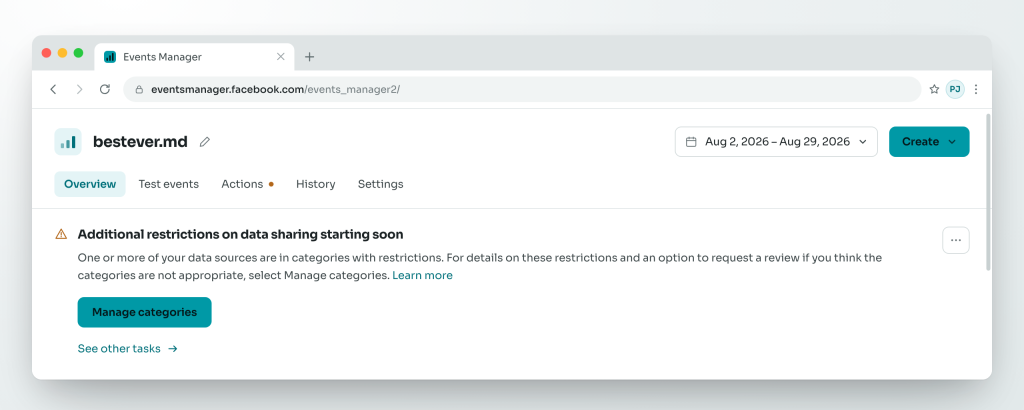
Anyone with access to Events Manager who isn’t a Meta BM admin can find out here that trouble is coming, and soon. But I doubt many PPC campaign managers spend much time in Events Manager, so this isn’t an easy way to find out either.
Events Manager is also where you appeal the decision, through the Manage categories button. Only bother if Meta’s automation genuinely got it wrong and put the site in a category it doesn’t belong to. If the categorization is correct, your job is to adapt to the new situation.
What happens after 30 days?
As soon as the grace period runs out, another system email arrives from Meta, and again only the Meta BM admins get it:
Important: One or more of your websites or apps is in a category with data sharing restrictions
Hi [client],
To help ensure the data you send to Meta is in compliance with our Meta Business Tool Terms, we’ve categorized data sources such as websites and apps associated with your business tools. Depending on the content of the data source, Meta may assign a category with data restrictions.
We’re writing to inform you that at least one of the data sources (websites or apps) sending events to your Meta Business Tool is in a category with data sharing restrictions.
Meta Business Tool:
bestever.md: 8123456789012345
Read the rest of the email
Specifically, some data sources may be in a core setup, have blocked events (like certain standard events), or have fully blocked data. The data source is in a category with restrictions because it:
- Provides or facilitates access to healthcare or healthcare and wellness providers, products or services
When your data source is in a category with restrictions, performance may be impacted for any ads optimizing on blocked events received from impacted data sources. You will also receive warnings about affected campaigns in the Ads Manager Campaigns table and when you create or edit campaigns.
Review your data sources to make sure they’re in the right category. If you think they aren’t, you can ask us to review them in Events Manager.
Note: We can use the data source’s category to help us determine and restrict certain kinds of information you can share through Meta Business Tools.
Thanks,
The Meta Business Team
And of course the Events Manager message changes too:
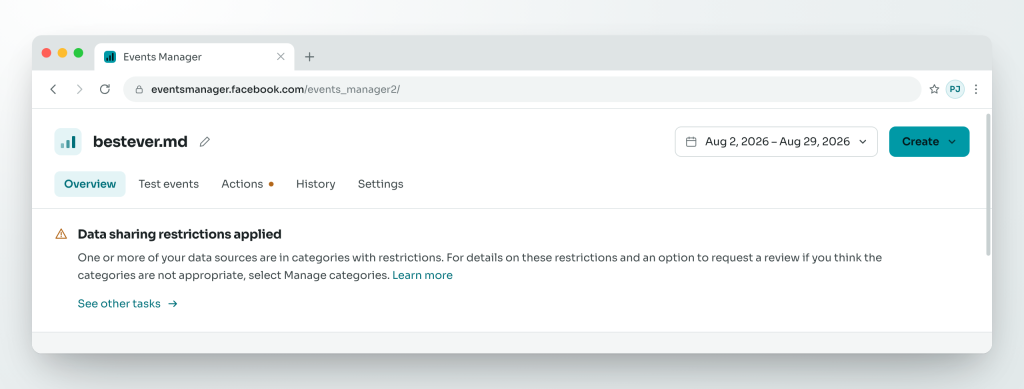
Does this mean you’ll never run a proper conversion campaign on Meta again? Thankfully not. But it definitely won’t work the way it used to.
What doesn’t fix Meta data sharing restrictions
The problem is the domain name. Which is exactly why dropping a new pixel into the site isn’t the answer. The domain is restricted, so a new pixel can’t send data from there to Meta either.
Implementing the Meta Conversions API is a great move in general, since Meta gets more data and pays you back with better results. But if you’re doing it to lift the restriction on your pixel, you’ll be disappointed. It won’t lift. Meta categorized the domain name itself, and the Meta data sharing restrictions came with that category.
One thing that could work is registering a new domain, moving the entire site over there, and shaping the page paths so Meta never figures out that you’re running a healthcare site. Kill that idea in the cradle. From a brand and SEO standpoint it’s the worst thing you can do.
What actually fixes Meta data sharing restrictions
The medium and full restrictions above have the same fix. Whether Meta blocks a couple of events or the entire domain, the business impact is roughly the same. Either way your ability to advertise takes a serious hit.
So the goal is to keep Meta from seeing the domain the data comes from, and to keep it from receiving a page path that could trigger the restriction all over again. Which means the Meta pixel has to go, because you can’t control what data it sends: wherever it fires, it hands over the site URL. The answer is a 100% Meta Conversions API setup, where Meta can only receive data through CAPI and the event source parameter in that data is rewritten so you’re not sending a restricted domain, or a page path that would likely trigger a restriction again.
Data sharing through CAPI only
You can build this properly with sGTM or with backend tracking. That can get expensive, and either way you’ll want an experienced team (a Crew 😉) on the project to solve it. One thing to watch closely during the build: don’t let event match quality sink through the floor afterward, or Meta won’t attribute properly.
In a CAPI-only setup that’s the biggest hurdle to clear. The mere presence of the Meta pixel does a lot of work for attribution, and without it you’re solving a lot of that by hand. Build a CAPI-only server-side setup badly and you’ll fall between two stools: you’ll have measurement, it just won’t be attributable. Given the complexity, a project like this can easily run into several thousand euros if you want data flowing to Meta again. Plenty of smaller businesses don’t have that budget.
And now the ace: Metamorph
We built Metamorph to cut through this Gordian knot. It’s subscription software at €100 per pixel per month plus VAT, which even the smallest restricted healthcare practice can earn back.
Under the hood, using Metamorph does essentially what sGTM tracking would do, only far more simply. Metamorph can step fully into the pixel’s shoes, storing the cookies you need for proper attribution, for instance. It then hands the data to Meta through the Conversions API, using a domain name generated for your site as the data source.
That’s how it gets around the restriction: Meta sees data arriving from a domain it has never encountered, one that isn’t on its restriction list. And since the data goes over without a page path, there’s nothing there to trigger a restriction on the new domain either.
Anyone with solid GTM-focused technical skills can roll out Metamorph, but for a limited time we’ll do the setup for you free of charge. The subscription starts with a free 7-day trial, which is plenty of time to see whether the tool works for you. And you can cancel Metamorph at any point.
Is your site restricted?
Meta data sharing restrictions are a fairly technical business, and they’re hard to spot from a client’s or a PPC manager’s seat. That’s what the Metamorph audit is for. Give it any site and it’ll tell you whether Meta is currently restricting it. Enter the domain name and the tool reports whether the site is:
- Not restricted
- Under a level one restriction
- Under a level two or three restriction ⬅️ this is where Metamorph, or an sGTM setup that solves the restriction, may be needed.
If a healthcare PPC prospect walks through your agency’s door, it’s worth running the Metamorph audit on their site before you send a proposal, so you know what you’re dealing with.
From all of us at DataCrew, we’re rooting for every advertiser and client caught up in this to get out from under it.
Key takeaways
- Meta data sharing restrictions don’t hit the pixel, they hit the domain name itself, which is why a new pixel won’t lift the restriction.
- There are three restriction levels, and the first one isn’t a serious problem.
- Roughly 41.2% of healthcare businesses across the countries we audited are affected. The rate ranges from 21.4% in Belgium to 53.8% in Italy.
- The restriction can be solved with a proper server-side setup or by rolling out Metamorph.